Gameschooling has an entry fee problem. A new board game runs thirty to eighty dollars, and the popular ones sit at the top of that. Buy four and that’s a week of groceries.
It doesn’t have to cost that, because you can definitely do gameschooling on a budget. Ours came together a few different ways: most bought with our homeschool funding, a few second-hand, some borrowed, a couple as Christmas presents. Here’s every route we know.
Start with what’s already in your house
Before you buy anything, go and look at what you own. A lot of families have five or six games in a closet and dismiss them as “just fun” without noticing what’s in them.
Uno is a lesson in sorting by two attributes at once. Monopoly is a lesson in percentages, negotiation, and why a bad early trade haunts you for an hour. Snakes and Ladders is a centuries-old argument, going back to ancient India, about whether luck or virtue gets you ahead. Ask a nine-year-old and they’ll have thoughts.
You are probably one closet away from your first three lessons.
Use your homeschool funding
If you’re homeschooling, check what your funding authority allows before you buy anything else. Many homeschool funding programs will cover board games as educational resources, as long as they’re tied to your program plan and you follow their claim process.
This is worth doing before anything else on this list. It’s money that was already yours, taken in taxes and going back toward your own children’s education. We’ve gotten a lot of our board games using our funding this way. It won’t look the same everywhere: some programs want an invoice, some want a reimbursement claim, some run through a purchase order. So the first step is just asking your own funding authority what they need to see.
Your library might lend more than books
A lot of libraries lend more than books now. Check if yours has a games collection: some catalogue them like any other item, others keep them behind the desk and you have to ask. If they don’t lend games outright, some run family game nights or maker-space sessions where you can try a game before deciding whether it’s worth owning.
If your library doesn’t have anything like this yet, it’s worth asking. Libraries add programs based on demand, and a request from a homeschool family is often exactly the kind of thing that gets one started.
Second-hand, done right
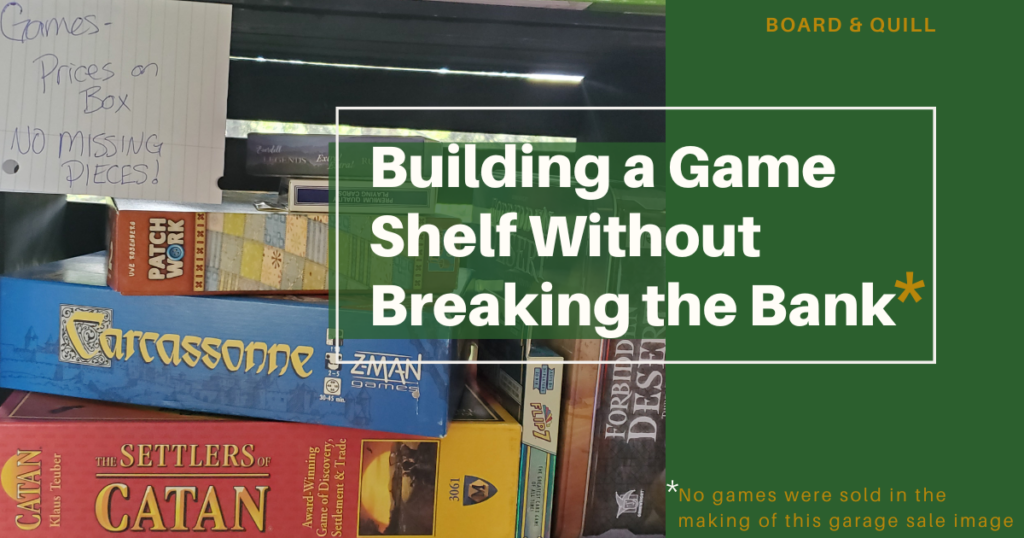
Second-hand shops, thrift stores, and yard sales are full of board games, usually for a few dollars. The catch is completeness: a $3 game missing half its pieces isn’t a deal.
Before you buy, open the box. Check the insert against what’s actually inside. Most games list the full component count on the inside of the lid or the rulebook’s back page. Count the cards if it’s card-based, check that every player color has its full set of pieces, and make sure the rulebook itself is in the box. If there’s no rulebook, most publishers post them free online, so that alone isn’t a dealbreaker, but missing pieces can be.
Some smaller second-hand stores go a step further and check every game and puzzle for completeness themselves, marking verified ones with a sticker. If you have one of these near you, it’s worth seeking out. It takes the guesswork out entirely.
The missing-piece trick
If your thrifted copy is missing a piece or two, don’t write it off yet. Most publishers will replace missing or damaged components for free. Look up the publisher’s website, there’s usually a contact form or a customer support email built for exactly this.
Proof of purchase isn’t always required, especially for a small missing piece, but policies vary by publisher, so it’s worth just asking. Worst case, they say no, and you’re no worse off than you were.
Borrow, lend, and swap
Ask around before you buy. We’ve borrowed games from family, and lent games to friends, and it costs nothing but a conversation. Most people have games sitting unplayed on a shelf and are happy to lend them out.
Some neighborhoods are even starting the board game version of the little free libraries you see on people’s front lawns, a small weatherproof box where anyone can take a game or leave one behind. If you have one nearby, it’s worth checking, and if you don’t, it might be worth starting.
If you want to make borrowing and lending a regular thing, a simple Game Swap works well. A handful of families each bring two or three games they’re willing to lend, everyone takes home something new, and you rotate again in a month or two. It’s a good excuse to get families together on a regular basis, and the games are almost a side benefit to the friendships that build around them.
At a swap, it’s worth adding a “take a game, leave a game” table alongside the lending, for games a family is genuinely done with. Instead of a loan, it’s a permanent trade, so your shelf refreshes without anyone spending a cent.
We’ll cover how to actually organize a Game Swap like this, including a free printable to help the organizer track who brought what and who borrowed which game, in a future post.
Try before you buy
Before you spend money on a game, see if you can play it first. We’ve played games at church, hosted co-op board game groups, and run family game nights, all without spending a cent on the games themselves.
If your own church or co-op doesn’t already do this, it’s an easy thing to start. Bring a few games from your own shelf, invite a handful of families, and everyone gets to try something new before deciding whether it’s worth owning. Board game cafés and local game shops sometimes run open game nights too, so it’s worth checking what’s near you.
None of these cost more than a few dollars, if anything, and they solve a real problem: a lot of the expensive-looking games on shelves are actually a poor fit for a given family once you’ve played them. Better to find that out for the price of a coffee than for the price of the game.
When you do buy, buy fewer
If you do spend money on a game, make it count. Look for games that teach more than one subject at once, since that’s more value out of a single box.
Our own homeschool authority actually publishes a handbook listing games alongside the subjects each one covers, and it’s been a genuine source of inspiration for us. We haven’t bought with that range-of-subjects lens specifically in mind yet, but it’s shaping what we look for next.
Even without a handbook like that, it’s worth doing the same exercise yourself before you buy: pick up a game you’re considering and ask what subjects it actually touches. A game that only teaches counting is a narrower buy than one that also touches strategy, negotiation, or history.
You don’t need a full shelf
You don’t need a full shelf to start gameschooling. Between what’s already in your closet, your funding authority, the library, second-hand shops, borrowed games, and a good Game Swap, most families can build a real rotation for less than the price of one new box.
Start with one game. Play it, teach from it, then look for the next one using whichever route fits. The shelf builds itself over time. It just doesn’t have to build itself out of your wallet.